


The U.S. Treasury Department has released a landmark congressional report under the GENIUS Act that could reshape how crypto platforms handle illicit finance. The report proposes a new “hold law” giving exchanges legal safe harbor to temporarily freeze suspicious digital assets, while simultaneously acknowledging, for the first time, that crypto mixers serve legitimate financial privacy purposes.
The dual-pronged approach signals a significant evolution in the Treasury’s crypto enforcement strategy: tighter tools for catching criminals, paired with greater recognition that privacy itself is not a crime. The report also flagged crypto ATMs as a growing fraud vector, with over $246 million in reported losses in 2024 alone. For Bitcoin holders, Ethereum users, and the broader crypto ecosystem, these proposals could define the rules of the road for years to come.
The “Hold Law” Proposal: What It Means
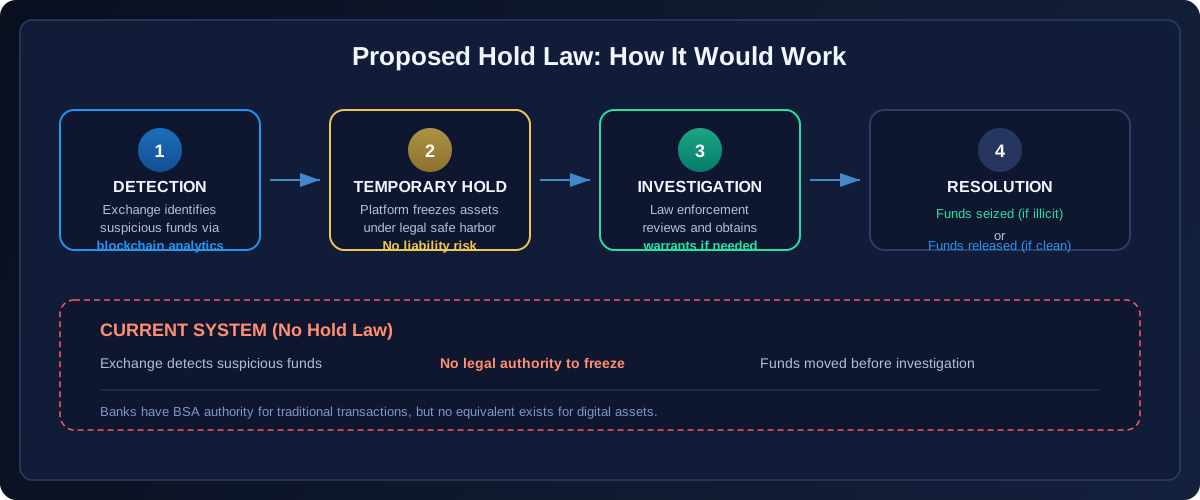
At the center of the Treasury report is a recommendation for Congress to create a digital asset-specific “hold law” that would allow crypto platforms to temporarily and voluntarily freeze digital assets suspected of involvement in illegal activity during active investigations.
The proposal addresses a critical gap in the current regulatory framework. Under the Bank Secrecy Act, traditional banks have narrow abilities to delay suspicious transactions. But crypto exchanges have no equivalent legal mechanism:
| Current System | Proposed Hold Law |
|---|---|
| Exchanges detect suspicious funds via blockchain analytics | Same detection capabilities remain |
| No clear legal authority to freeze assets | Legal safe harbor to temporarily hold assets |
| Risk of liability for pausing transactions | Protection from legal exposure during holds |
| Funds can be moved or converted before law enforcement acts | Law enforcement gets time to obtain warrants |
| No established “pending state” for crypto | Creates a formal freeze mechanism |
The proposal is designed to benefit exchanges as much as regulators. Platforms like Coinbase, Binance, and Kraken already use sophisticated blockchain intelligence tools to flag potentially illicit transactions. But without clear legal authority, freezing those funds creates liability risk: either the exchange lets suspicious funds flow and risks enforcement action, or it freezes them and risks lawsuits from account holders.
Treasury Reverses Course on Crypto Mixers
Perhaps the most surprising element of the report is the Treasury’s acknowledgment that crypto mixers have legitimate uses. The department stated that “lawful users of digital assets may leverage mixers to enable financial privacy when transacting through public blockchains.”
Specifically, the Treasury noted that individuals may use mixers to:
- Protect personal wealth information from appearing on public blockchains
- Shield business payment details from competitors or bad actors
- Maintain privacy for charitable donations made through digital assets
This represents a dramatic shift from 2022, when the Treasury’s Office of Foreign Assets Control (OFAC) sanctioned Tornado Cash, a prominent Ethereum-based mixer, labeling it primarily as a money-laundering tool used to process over $7 billion in transactions. That action drew widespread criticism from the crypto community and civil liberties advocates, leading to legal challenges that are still winding through courts.
Key milestones in the Treasury’s mixer stance:
- August 2022: OFAC sanctions Tornado Cash, blocking all U.S. interactions with the protocol
- October 2023: FinCEN proposes labeling crypto mixers as a “primary money laundering concern”
- January 2026: U.S. government seizes $400 million from Helix, a darknet mixer
- March 2026: Treasury report acknowledges mixers have “legitimate financial privacy” uses
The new report does not reverse the Tornado Cash sanctions or suggest that all mixer activity is lawful. It maintains that non-custodial “darknet” mixers remain a concern, particularly those used by North Korea-linked hackers who stole approximately $2.8 billion between January 2024 and September 2025. But the explicit recognition of legitimate use cases opens the door for more nuanced regulation.
Crypto ATM Fraud: A Growing Threat
The report also sounded a strong warning on crypto ATMs, identifying them as a rising vector for consumer fraud:
- 10,900+ complaints filed regarding crypto ATM fraud in 2024
- $246.7 million in total reported losses
- Older individuals face disproportionately higher fraud risks
- Scammers commonly pose as government agents, company representatives, or investment advisors
The fraud pattern is straightforward but effective. Scammers contact victims through phone calls, emails, or texts, create a false sense of urgency (unpaid taxes, security breaches, investment opportunities), and pressure them to deposit cash at a crypto ATM. The funds are immediately converted to cryptocurrency and moved through multiple wallets, making recovery extremely difficult.
The Treasury recommended stronger monitoring systems, advanced fraud detection tools, and clearer consumer warning requirements for crypto ATM operators.
The GENIUS Act: Context and Framework
All of these recommendations flow from the GENIUS Act (Guiding and Establishing National Innovation for U.S. Stablecoins), which President Trump signed into law on July 18, 2025. The Act established the first major federal regulatory framework for payment stablecoins in the United States.
Key GENIUS Act provisions:
- Federal oversight framework for payment stablecoin issuers
- Reserve requirements: Issuers must hold liquid reserves (cash, Treasury securities, or approved instruments) equal to the value of outstanding stablecoins
- Custody and safekeeping standards enforced by the OCC
- State preemption: Federal rules override conflicting state regulations
- Effective date: January 18, 2027, or 120 days after regulators issue final rules (whichever comes first)
The March 2026 Treasury report represents one of the first major policy deliverables under the GENIUS Act’s mandate for ongoing review and recommendation. It also proposed clarifying anti-money laundering obligations for DeFi platforms and advancing privacy-preserving digital identity tools as emerging compliance solutions.
What This Means for the Crypto Industry
The Treasury’s proposals have different implications depending on which part of the ecosystem you occupy:
For exchanges (Coinbase, Binance, Kraken):
- Clear legal authority to freeze suspicious assets would reduce compliance uncertainty
- Stronger partnerships with law enforcement could improve institutional reputation
- Implementation costs for hold mechanisms and reporting infrastructure will increase
For DeFi protocols:
- The call to clarify AML obligations for DeFi platforms signals increased regulatory attention
- Protocols may need to integrate compliance tools or face enforcement risk
- Cross-chain bridges and mixing protocols face particular scrutiny
For privacy-focused projects (Monero, Zcash):
- Treasury’s acknowledgment of legitimate privacy needs is broadly positive
- The distinction between privacy technology and its misuse provides a potential regulatory path forward
- Projects that can demonstrate compliance compatibility may benefit from the new stance
For consumers and investors:
- Crypto ATM users should exercise heightened caution against scam calls and urgency-based fraud
- The hold law could temporarily delay withdrawals flagged as suspicious
- Stronger compliance frameworks may improve overall market integrity
Risks and Open Questions
Several issues remain unresolved in the Treasury’s proposal:
- Blockchain analytics reliability: The report does not address concerns about false positives from chain analysis tools that could lead to wrongful freezes
- Tipping off restrictions: Current suspicious activity reporting (SAR) rules prohibit alerting subjects of investigations, creating tension with any hold or freeze mechanism
- Scope creep: Critics worry that a hold law could be expanded beyond its original intent to enable broader asset seizures
- International coordination: With USDC and USDT operating globally, a U.S.-only hold law creates jurisdictional arbitrage opportunities
- Timeline: Congress has not yet scheduled hearings on the hold law proposal, and the legislative calendar is crowded with the CLARITY Act and other priorities
This is not financial advice. Regulatory proposals are subject to change through the legislative process. Always conduct your own research and consult qualified professionals before making investment decisions.
Related Reading
- SEC Project Crypto: Regulatory Clarity Push for Bitcoin in 2026
- Turkey’s Ruling Party Unveils 10% Crypto Income Tax Proposal
Sources
- CoinDesk: U.S. Treasury signals shift on crypto mixers, acknowledges legitimate privacy uses
- Decrypt: Treasury Urges Congress to Give Crypto Platforms Power to Freeze Suspicious Funds
- CoinCentral: U.S. Treasury Warns Crypto ATMs Are Becoming a Major Tool for Scammers
- Reuters: Understanding the GENIUS Act
- OCC: GENIUS Act Regulations: Notice of Proposed Rulemaking
- Cointelegraph (via TradingView): US Treasury report acknowledges legitimate uses of crypto mixers