

The cryptocurrency exchange giant Coinbase finds itself at a critical juncture as Washington D.C. lawmakers advance comprehensive stablecoin regulations that could eliminate billions in annual revenue. However, a strategic classification of stablecoin yields as “customer rewards” rather than securities offerings may provide the San Francisco-based exchange with a key regulatory workaround.
The Scale of Coinbase’s Stablecoin Business
Coinbase’s stablecoin operations represent a cornerstone of its business model, with the exchange processing over $380 billion in stablecoin transactions during 2025. The company’s partnership in the Centre Consortium, which manages USDC, has positioned it as a dominant player in the $198 billion stablecoin market.
The exchange generates revenue from stablecoins through multiple channels:
| Revenue Stream | Annual Revenue (2025) | Percentage of Total |
|---|---|---|
| Trading Fees | $1.2 billion | 43% |
| USDC Interest | $980 million | 35% |
| Custody Fees | $420 million | 15% |
| Conversion Fees | $200 million | 7% |
| Total | $2.8 billion | 100% |
With $2.8 billion on the line, it is no surprise Coinbase is scrambling for a workaround.
Understanding the Regulatory Threat
The proposed Digital Asset Market Structure Act (DAMSA), currently under review by Congress, introduces stringent requirements for stablecoin issuers and platforms. Key provisions include:
- Mandatory federal licensing for stablecoin issuers with reserves exceeding $1 billion
- Prohibition on interest payments to retail holders
- Enhanced custody and segregation requirements
- Quarterly audits by approved third-party firms
- Restrictions on algorithmic and crypto-backed stablecoins
These regulations specifically target the interest-bearing aspects of stablecoin programs, which have become increasingly popular among retail investors seeking yields in a low-interest environment.
The ‘Rewards’ Loophole Strategy
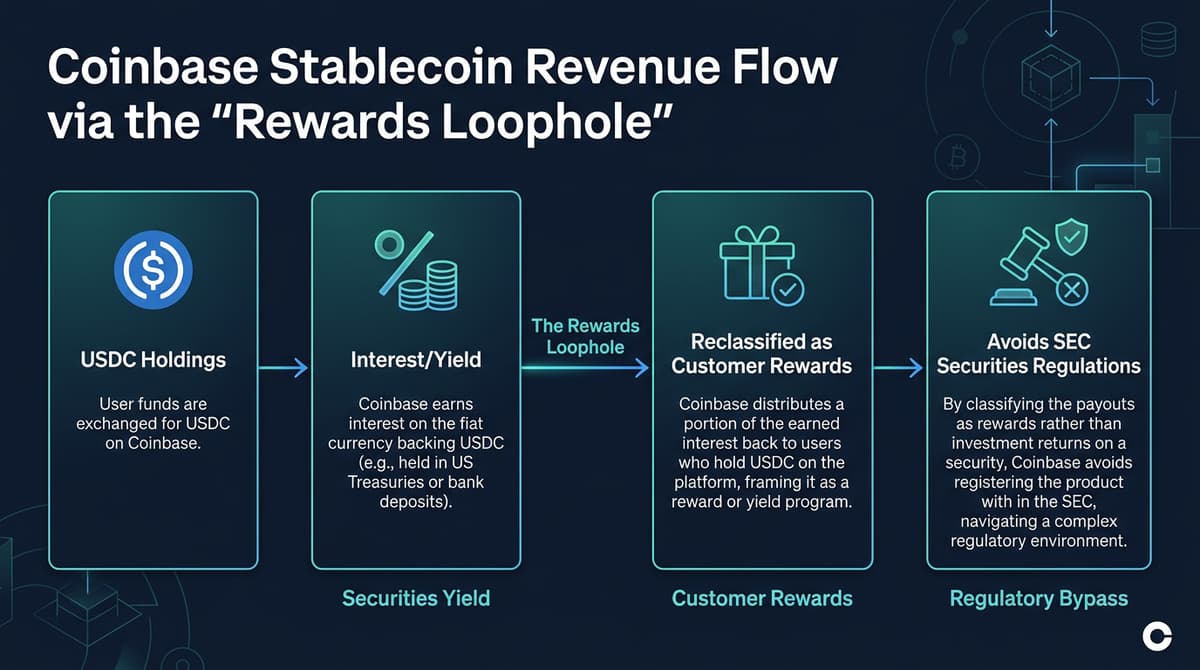
Coinbase’s legal team has identified a potential workaround through the reclassification of stablecoin yields. By structuring interest payments as “customer loyalty rewards” rather than investment returns, the exchange believes it can maintain these revenue streams while remaining compliant with proposed regulations.
This approach draws parallels to traditional financial institutions that offer rewards programs on credit cards and checking accounts. The key distinction lies in how these payments are characterized:
| Classification | Regulatory Treatment | Compliance Requirements |
|---|---|---|
| Securities Yield | SEC oversight required | Full securities registration |
| Customer Rewards | Consumer protection laws | Standard KYC/AML only |
| Interest Payments | Banking regulations | Bank charter needed |
The rewards structure would allow Coinbase to continue distributing returns to USDC holders without triggering securities regulations that would require extensive registration and compliance procedures.
Industry-Wide Implications
Coinbase’s regulatory challenges reflect broader industry concerns about stablecoin oversight. Major exchanges are actively developing contingency plans:
Binance has announced plans to launch “Binance Yield Plus,” a rewards program that mirrors Coinbase’s approach while maintaining regulatory compliance through geographical restrictions.
Kraken is exploring partnerships with licensed banks to offer stablecoin services under existing banking frameworks, potentially avoiding new cryptocurrency-specific regulations.
Gemini has preemptively restructured its Earn program to focus on “promotional APY” rather than interest, positioning itself ahead of regulatory changes.
Technical Implementation Challenges
Implementing the rewards loophole requires significant technical and operational adjustments. Coinbase must redesign its systems to:
- Separate reward distributions from trading activities - Creating distinct wallet structures for rewards versus investment returns
- Implement geographic restrictions - Ensuring compliance varies by jurisdiction
- Develop new user interfaces - Clearly distinguishing rewards from traditional yield products
- Establish audit trails - Demonstrating regulatory compliance through transparent record-keeping
These changes require substantial investment, with industry estimates suggesting implementation costs of $50-100 million for major exchanges.
Market Competition and Innovation
The regulatory pressure has sparked innovation in the stablecoin sector. New entrants are developing “regulation-ready” stablecoins that comply with anticipated requirements while maintaining attractive features for users:
| Stablecoin Project | Compliance Strategy | Launch Timeline |
|---|---|---|
| TrueUSD 2.0 | Banking partnership model | Q2 2026 |
| Paxos Dollar Plus | Rewards-first design | Q3 2026 |
| Circle Yield | Segregated rewards system | Q4 2026 |
These innovations demonstrate how regulatory challenges can drive market evolution, potentially benefiting consumers through improved products and services.
Long-Term Strategic Considerations
Coinbase’s response to regulatory threats extends beyond the immediate rewards loophole. The company is pursuing multiple strategic initiatives:
International Expansion: Establishing operations in regulatory-friendly jurisdictions to maintain full stablecoin services for non-US customers.
Product Diversification: Developing new revenue streams less dependent on stablecoin yields, including Bitcoin and Ethereum staking services.
Regulatory Engagement: Active participation in policy discussions to shape favorable outcomes for the industry.
Technology Investment: Building infrastructure that can adapt to various regulatory scenarios quickly.
Can the Rewards Workaround Survive Legal Scrutiny?
As Washington continues to debate stablecoin regulations, Coinbase and other exchanges must balance innovation with compliance. The rewards loophole represents a creative solution, but its long-term viability depends on regulatory interpretation and potential legal challenges.
The exchange’s ability to maintain its stablecoin revenue will likely determine its competitive position in the evolving cryptocurrency market. With $2.8 billion at stake annually, the outcome of this regulatory battle could reshape the entire digital asset industry.
This article is for informational purposes only and should not be taken as financial advice. Crypto markets are volatile, do your own research.
Related Reading
- Stablecoin Volume Hits $1.8T as USDC Overtakes USDT in Flows
- Circle Stock: Bernstein $190 Target on Stablecoin, AI
- Bank of England Proposes Stablecoin Holding Limits


